BLACK LOYALIST HERITAGE CENTRE

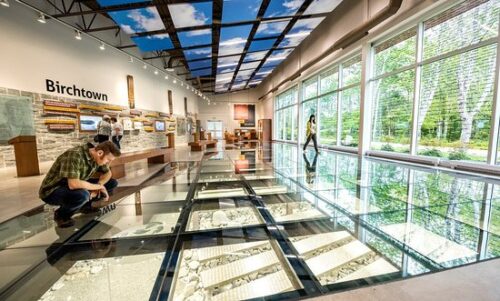
The Black Loyalist Heritage Centre is a 10,500 square foot facility, housing the Black Loyalist Heritage Society offices and museum, as well as a gift shop.

For information about admission, operating hours, and to plan your visit to the Centre and Site, click here.

Lindsay Exhibition Gallery

Step inside the Lindsay Exhibition Gallery to for an interactive journey through the history of the Black Loyalists…

Featuring world-class displays, the Lindsay Gallery offers visitors a depth of information on the history of the Black Loyalists from 1500 to present day.

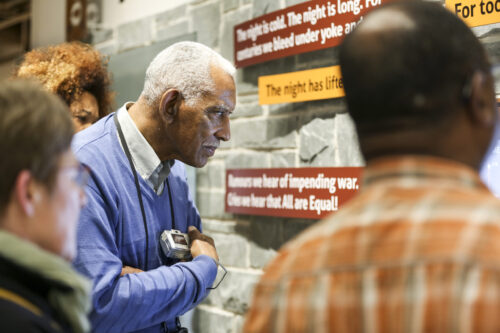
Follow the timeline wall down the length of the centre. Here you will encounter four screens, each with an in depth focus on a different portion of the Black Loyalist history.

Who Were the Black Loyalists? – on this screen you will learn the beginnings of the Black Loyalist journey with freedom in Africa, enslavement in America and how thousands earned their freedom on the side of the British during the American Revolution.

Life in Birchtown – the Black Loyalists were promised freedom for their service to the British. Upon their arrival they were met with broken promises, threat of re-enslavement and hardships which are detailed here.

Exodus to Sierra Leone, – on our third screen you will follow 1/3 of the Black Loyalist population as they leave Nova Scotia to journey to Sierra Leone and establish the Freetown colony.

Impact & Legacy – at the end of your journey through the timeline wall, we bring you to present day. Here you will learn about the Black Loyalist descendants, their communities, and the ongoing effort to preserve and tell the story of the Black Loyalists. 

Carleton's Book of Negroes

Flip through the pages of our virtual copy of the Book of Negroes document where you will find the names of Black Loyalists traveling to Nova Scotia…

This interactive display allows visitors to search through over 3,000 listings and find names of original Black Loyalists.

The Book of Negroes was compiled as an inventory of African Americans who left New York with the Britsh. Two copies were recorded at the same time. One by the Americans and one by the British. The Americans inteded to use the inventory to claim financial compensation from the British for losses during the war. This included claims of slaveholders who flooded New York City to try to re-enslave Black Loyalists.

The Book gives a description of the person, a name, name of their former enslaver, the name of the ship they left on, the captain’s name, destination, past and present status, and the port and date of embarkation. Some paid their own way and were therefore indebted to no one.

Archaelogical Pit

See historic artificats from the time of the Black Loyalists beneath your feet…

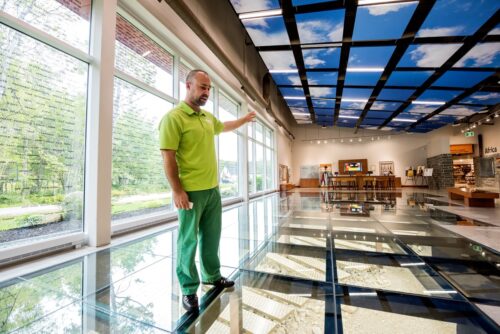
As you walk across the glass floor, be sure to look under your feet to see just some of the many artifacts uncovered here in Birchtown during archaeological digs.

The first archaeological survey of Birchtown occured in 1993, led by archaeologists Stephen Powell and Laird Niven. On the preliminary excavation they found just under 300 artifacts along with a network of stone walls and 22 depressions that may have been cellars. This led to a number of exciting digs, that uncovered over 16 thousand artifacts dating back to the time period of the Black Loyalists.

Many of the artifacts on display at the centre are from the 1998 dig at the Acker Site. These excavations uncovered what is believed to be the home of Col. Stephen Blucke, a Black Pioneer and leader of the Black Loyalists in Birchtown.

The Black Loyalist Heritage Centre represents the very best of opportunity, community activism and commitment to grow in the wake of oppression and loss. In 2006, an arsonist set fire to the office of the Black Loyalist Heritage Society, destroying many of its valuable archives and historical papers. Instead of being defeated by the act of aggression, the staff, board members and volunteers of the Society pursued a dream they had already been nourishing to build an interpretive centre that would do justice to the complex story of its people.

People of African descent have been in what is now Canada since the opening years of the 17th century, but the first massive wave of Black immigration into Canada took place in 1783, when about 3,000 Black Loyalists fled New York City after aiding the British on the losing side of the American Revolutionary War and sailed to Nova Scotia. They settled in Annapolis Royal, Digby and Saint John (then Nova Scotia) among other communities, but the largest Black settlement became Birchtown, just outside the booming town of Shelburne.

The story of the Black Loyalists — how they served the British in the war in exchange for the promise of freedom in peacetime, and how they travelled to Nova Scotia only to endure hardships of slavery, indentured servitude, landlessness and hunger — is one of the great stories of Canadian history. Their perseverance, as well as the decision made by about 1,200 of them to leave Canada and to sail across the Atlantic Ocean to found the colony of Freetown in Sierra Leone in 1792 — suggests the breadth and complexity of the world-wide migrations they had experienced as a result of the trans-Atlantic slave trade and its aftermath. Although many Nova Scotians joined the exodus to Sierra Leone in 1792, even more stayed behind to continue to build the province of Nova Scotia as we know it today.

Their descendants stand proudly as members of the Black Loyalist Heritage Society and as creators of this Centre.

Lawrence Hill
Author, The Book of Negroes
Funding for the Black Loyalist Heritage Centre was made possible by the following government agencies:

Canada Cultural Spaces Fund, Canadian Heritage
Atlantic Canada Opportunities Agency
Citizenship & Immigration Canada, Inter-Action Program
The Province of Nova Scotia
Nova Scotia Department of Communities, Culture & Heritage
The Nova Scotia Museum Board of Governors
The Municipality of the District of Shelburne
The Town of Shelburne

We would also like to extend our sincere appreciation to our many private donors.  Your donations helped to ensure our centre was built so that we can preserve the Black Loyalist story and tell it both to our children and grandchildren and to the many visitors to our province from near and far.  We thank you for helping us to recover our heritage.

BIRCHTOWN'S HISTORICAL SITE

The Black Loyalist Heritage Site, located in Birchtown, Nova Scotia, is an interpretive site situated on a stunning two acre property overlooking the Birchtown Bay and Shelburne Harbour.

The site is part of the Black Loyalist Heritage Society complex, and is included with admission to the Black Loyalist Heritage Centre.

Old School House Museum

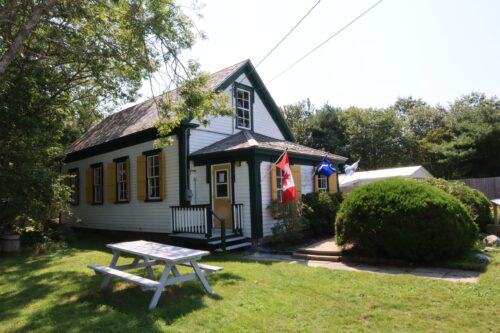
Step inside this one room schoolhouse, dating back to 1835, and see artifacts from the Birchtown community.

Built around 1835, this one room school house served the Birchtown community until 1960. The school was built on land that belonged to Roswell Brown, a white schoolmaster who had come to Nova Scotia from Albany, New York with the Church of England in the early 1800s. After working in Liverpool and Port Mouton, Brown arrived in Birchtown in 1825 and established this schoolhouse.

This was not the first schoolhouse in Birchtown. The first Black Loyalists to arrive here had a school of their own, established in 1785. The schoolmaster was Colonel Stephen Blucke, a prominent Black Loyalist in the community. He operated the school until 1796. The next school opened a short time later in 1798, and was established for the Black children of Birchtown by the Warden of the Christ Church.

Brown’s schoolhouse was replaced by the Birchtown Consolidated School. After its life as a schoolhouse, the Old Schoolhouse served as the Birchtown Community Hall, then a storage building before ultimately being acquired for preservation by the Black Loyalist Heritage Society in 1997.

The Old Schoolhouse acted as the original Black Loyalist Museum when the Heritage Site opened in 2000. Today the museum houses artifacts from the Birchtown community, and an exhibit on the history of schooling within Birchtown. 

Aminata’s Walk

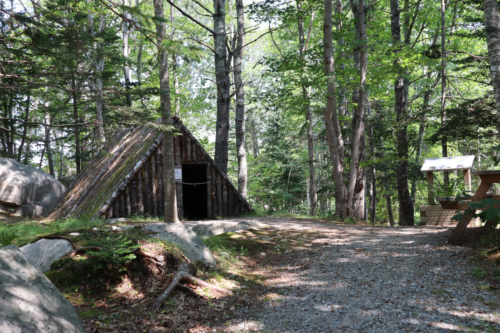
Follow the path along our walking trail and discover the pit house, showing the types of shelters Black Loyalist lived in after their arrival to Nova Scotia.

While visiting our site, be sure to take a walk along our heritage trail, Aminata’s Walk. The trail takes it name from the central character of Lawrence Hill’s award winning novel, The Book of Negroes

Along the walk you will encounter a replica of a pit house. These make-shift shelters were built by the Black Loyalists to survive here in Nova Scotia. The structure gets its name from the fire pits which were dug in the center of the dwelling. Black Loyalists would sleep along the outer edge of the fire, with a roof above them fashioned with logs and moss.

Archaeological digs show evidence of pit houses around the Birchtown area.

St. Paul’s Anglican Church

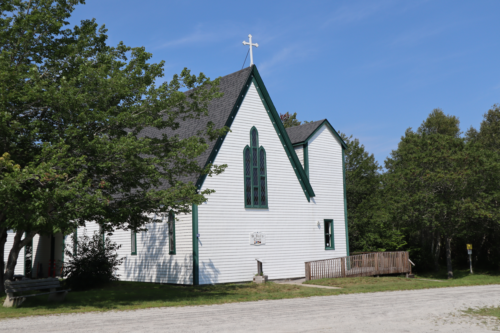
Step inside this historic church, situated in the heart of the Birchtown community. The church is a reminder of the strong faith the Black Loyalists had.

Faith was very important in the lives of the Black Loyalists – and it remains so for many of their descendants. Construction of St. Paul’s Anglican Church began in 1888, and was completed in 1905 on land sold by Black Loyalist, Enoch Scott. When the church officially opened it boasted 33 charter members under Priest in Charge, Reverend Edward H. Ball  with 54 families wishing to be appropriated pews in the church.

As was the case with many churches in smaller communtieis, the congregation of St. Paul’s Anglican Church dwindled. By the 1980s the church fell into disuse and closed its doors.

In 1996 the Black Loyalist Heritage Society acquired St. Paul’s Anglican Church for preservation as part of the Heritage Site in Birchtown. Today, the church remains a favorite spot for visitors of the site, and has been host to a number of events including re-enactments, quilt shows, and weddings.

Black Burial Ground & Monument Site

On the edge of the Birchtown Bay sits the Black Burial Ground and Monument Site. This quiet spot is a perfect area for reflection at the end of your visit to the Heritage Site.

In 1994 the Black Loyalist Heritage Society made application to the National Historic Sites and Monuments Board to have the landing of the Black Loyalists in Canada recognized as an event of national historic import. The National Historic Sites and Monuments approved the Black Loyalist Heritage Society’s application and honoured the Black Loyalists by creating a park and unveiled a monument in their memory in Birchtown, Shelburne County, Nova Scotia on July 20th, 1996. Legend and local oral folklore hold that this piece of land was a burial ground for Blacks. There is no formal record of the burial ground, though historical deeds from two adjoining plots of land mention that the properties border on “the burial ground”. Families in the area remember being told not to play on the site because it was sacred ground.

There are no records as to who may be buried on the site, though one church record suggests that a man named John Stevens, who died in the 1800’s, was buried “on the northwestern side of Shelburne Harbour” most likely in Birchtown. Unfortunately, most old church records were destroyed in a house fire.